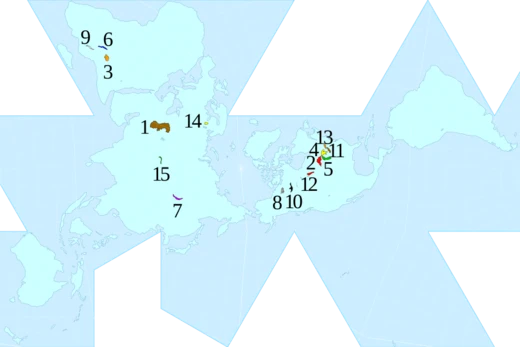
Lake Van
Turkey's largest lake, a saline endorheic body in the Armenian highlands.

Lake Van is the largest lake in Turkey. It lies in the Eastern Anatolia region of Turkey in the provinces of Van and Bitlis, in the Armenian highlands. It is a saline soda lake, receiving water from many small streams that descend from the surrounding mountains. It is one of the world's few endorheic lakes of size greater than 3,000 square kilometres and has 38% of the country's surface water. A volcanic eruption blocked its original outlet in prehistoric times. It is situated at 1,640 m above sea level.
- type
- Saline soda lake
- location
- Eastern Anatolia, Turkey (provinces of Van and Bitlis)
- area
- 3,755 km²
- volume
- 607 km³
- max_depth
- 451 m
- elevation
- 1,640 m above sea level
- formed
- More than 600,000 years ago
Lore & Background
Lake Van is primarily a tectonic lake, formed more than 600,000 years ago by the gradual subsidence of a large block of the Earth's crust due to movement on several major faults. The lake's southern margin demarcates a metamorphic rock zone of the Bitlis Massif and volcanic strata of the Neogene and Quaternary periods. The lake's proximity to the Karlıova triple junction has led to molten fluids of the Earth's mantle accumulating in the strata beneath, still driving gradual change. Dominating the lake's northern shore is the stratovolcano Mount Süphan. The broad crater of a second, dormant volcano, Mount Nemrut, is close to the western tip of the lake. There is hydrothermal activity throughout the region. For much of its history, until the Pleistocene, Lake Van had an outlet towards the southwest into the Murat River and eventually into the Euphrates river. However, the level of this threshold has varied over time, as the lake has been blocked by successive lava flows from Nemrut volcano westward towards the Muş Plain. This threshold has then been lowered at times by erosion.
Reader's Guide
Lake Van is 119 kilometres across at its widest point. It averages 171 metres deep. Its greatest known depth is 451 metres. The surface lies 1,640 metres above sea level and the shore length is 430 kilometres. It covers 3,755 km² and contains 607 cubic kilometres. The western portion of the lake is deepest, with a large basin deeper than 400 m lying northeast of Tatvan and south of Ahlat. The lake water is strongly alkaline (pH 9.7–9.8) and rich in sodium carbonate and other salts. Some is extracted in salt evaporation ponds alongside, used in or as detergents. Despite the high altitude and winter averages below 0 °C, high salinity usually prevents it from freezing; the shallow northern section can freeze, but rarely. The PALEOVAN project studied the lake's paleolimnology, paleoclimatology, and sedimentology over the last 600,000 years using seismic reflection and continuous cores. They found that the lake level has varied by as much as 600 m during the past 600,000 years, with five major lowstands circa 600, 365–340, 290–230, 150–130, and 30–14 ka BP. The level of the lake rose by at least 3 m during the 1990s, drowning much agricultural land, and rose approximately 2 m in the 10 years immediately prior to 2004. But in the early 2020s it fell.
Did You Know?
- Lake Van is one of the world's few endorheic lakes of size greater than 3,000 square kilometres.
- The lake holds 38% of Turkey's surface water, including rivers.
- The only fish known to live in the brackish water was Alburnus tarichi (Pearl Mullet) until a new species, Oxynoemacheilus ercisianus, was discovered inside a microbialite in 2018.
- Researchers reported 40 m tall microbialites in the lake in 1991, formed by coccoid cyanobacteria.
- The PALEOVAN project found that the lake level has varied by as much as 600 m over the past 600,000 years.
Frequently Asked Questions
What is Lake Van?
Lake Van is Turkey's largest lake, a saline soda body sitting in the Armenian highlands of Eastern Anatolia. It spans roughly 3,755 square kilometers across the provinces of Van and Bitlis.
Why is Lake Van a soda lake?
Because it is endorheic—meaning it has no natural outlet—dissolved minerals and salts build up over time, giving the water its alkaline, soda-rich character. Its original drainage channel was sealed off by a prehistoric volcanic eruption.
How deep is Lake Van?
The lake reaches a maximum depth of 451 meters and holds about 607 cubic kilometers of water. That volume accounts for roughly 38% of all surface water in Turkey.
Where exactly is Lake Van located?
It sits in the Eastern Anatolia region of Turkey, straddling the provinces of Van and Bitlis, at an elevation of 1,640 meters above sea level. The basin occupies the Armenian highlands plateau.
How did Lake Van become a closed basin?
A volcanic eruption in prehistoric times blocked the lake's original outlet, turning it into a closed, endorheic system. That single event set the stage for the mineral-rich, saline conditions the lake retains today.
More in Lakes Of The World 1-18
Spotted an error? Know more?
This is a living reference — every entry is fact-audited, and reader corrections feed straight into our audit queue. Suggest an edit · See this site's audit record