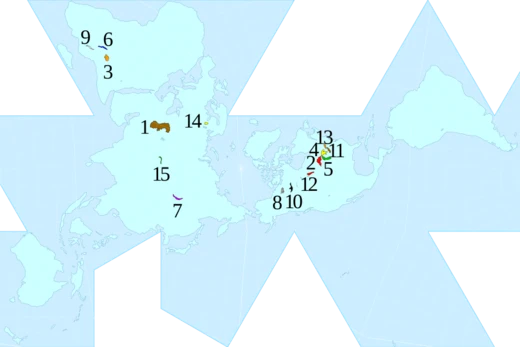
Lake Victoria
Africa's largest lake by area and source of the Nile.

Lake Victoria is one of the African Great Lakes. With a surface area of approximately 59,947 km2 (23,146 sq mi), it is Africa's largest lake by area, the world's largest tropical lake, and the world's second-largest fresh water lake by surface area after Lake Superior in North America. In terms of volume, Lake Victoria is the world's ninth-largest continental lake, containing about 2,424 km3 of water. The lake's area is divided among three countries: Tanzania occupies 49%, Uganda 45%, and Kenya 6%.
- surface_area
- approximately 59,947 km²
- average_depth
- 40 m
- maximum_depth
- 80–81 m
- volume
- about 2,424 km³
- countries
- Tanzania (49%), Uganda (45%), Kenya (6%)
- primary_outflow
- Nile River
- age
- relatively geologically young at about 400,000 years
Verified Timeline
Lore & Background
Lake Victoria occupies a shallow depression in Africa. Photojournalist John Reader, writing in his Alan Paton Literary Award-winning *Africa: A Biography of a Continent*, describes Lake Victoria as being relatively geologically young at about 400,000 years old—having been formed as westward-flowing rivers were backed up 'when a fractured block of the Earth's crust tilted along the line of the Great Rift Valley, raising its western edge.' Geological cores taken from its bottom show Lake Victoria has dried up completely at least three times since it formed. According to another primary source, Lake Victoria last dried out about 17,300 years ago, and it refilled 14,700 years ago—as the African humid period began. The lake receives 80 percent of its water from direct rainfall. Average evaporation on the lake is between 2.0 and 2.2 metres per year, almost double the precipitation of riparian areas. Lake Victoria is drained solely by the Nile River near Jinja, Uganda, on the lake's northern shore. In terms of contributed water, this makes Lake Victoria the principal source of the longest branch of the Nile.
Reader's Guide
Lake Victoria is Africa's largest lake by area and the world's largest tropical lake. It is a critical water source for the Nile River and supports a vast ecosystem, including many endemic fish species, especially cichlids. The lake is home to many species of fish which live nowhere else, especially cichlids. Invasive fish, such as the Nile perch, have driven many endemic species to extinction. The lake exhibits eutrophic conditions. In 1990–1991, oxygen concentrations in the mixed layer were higher than in 1960–1961, with nearly continuous oxygen super saturation in surface waters. Oxygen concentrations in hypolimnetic waters were lower in 1990–1991 for a longer period than in 1960–1961, with values of less than 1 mg per litre occurring in water as shallow as 40 metres compared with a shallowest occurrence of greater than 50 metres in 1961. These changes have arisen for multiple reasons: successive burning within its basin, soot and ash from which has been deposited over the lake's wide area; from increased nutrient inflows via rivers, and from increased pollution associated with settlement along its shores. Between 2010 and 2022, the surface area of Lake Victoria increased by 15% flooding lakeside communities. The main group of fish in Lake Victoria is the haplochromine cichlids, with more than 500 species, almost all endemic, and including an estimated 300 that still are undescribed. Their extraordinary diversity and speed of evolution have been the subjects for many scientists studying the forces that drive the richness of life everywhere.
Did You Know?
- Lake Victoria has dried up completely at least three times since it formed, with the last drying about 17,300 years ago.
- The lake receives 80% of its water from direct rainfall, and average evaporation is between 2.0 and 2.2 metres per year.
- Between 2010 and 2022, the surface area of Lake Victoria increased by 15%, flooding lakeside communities.
- The lake is home to more than 500 species of haplochromine cichlids, almost all endemic, with an estimated 300 still undescribed.
- The only outflow from Lake Victoria is the Nile River, which exits near Jinja, Uganda.
Frequently Asked Questions
Who is Lake Victoria?
Lake Victoria is Africa's largest lake by surface area and the biggest tropical freshwater body on the planet. It stretches across the borders of Tanzania, Uganda, and Kenya, covering roughly 59,947 square kilometers.
What are Lake Victoria's key stats?
The lake sits at an average depth of about 40 meters, dips to a maximum of roughly 80–81 meters, and holds around 2,424 cubic kilometers of water. By surface area it is the second-largest freshwater lake globally, trailing only Lake Superior.
How does Lake Victoria's story end?
Its waters feed into the principal branch of the Nile River, effectively launching one of the world's longest river systems. In that sense, the lake's 'ending' is the Nile's beginning, carrying the flow all the way to the Mediterranean Sea.
Who shares Lake Victoria and how is the shoreline divided?
Tanzania claims about 49% of the shoreline, Uganda holds roughly 45%, and Kenya accounts for the remaining 6%. All three nations jointly manage the lake's fisheries, water quality, and surrounding ecosystems.
Why is Lake Victoria important to the broader story?
It acts as the principal source feeding the longest branch of the Nile and sustains the livelihoods of tens of millions of people across three countries. As Earth's largest tropical lake, it also plays a pivotal role in African biodiversity and regional climate regulation.
More in Lakes Of The World 1-18
Spotted an error? Know more?
This is a living reference — every entry is fact-audited, and reader corrections feed straight into our audit queue. Suggest an edit · See this site's audit record