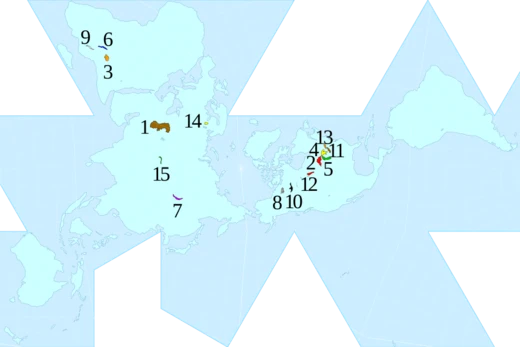
Lake Volta
World's largest artificial reservoir by surface area, in Ghana.

Lake Volta is the largest artificial reservoir in the world by surface area, contained behind the Akosombo Dam which generates a substantial amount of Ghana's electricity. It is completely within the country of Ghana and has a surface area of 8,502 square kilometres (3,283 sq mi). It extends from Akosombo in the south to the northern part of the country southwest of Tamale.
- surface_area
- 8,502 square kilometres (3,283 sq mi)
- location
- Ghana
- formed_by
- Akosombo Dam
- length
- 520 km (320 mi) from Akosombo Dam to Yapei
- primary_inflow
- White Volta River and Black Volta River
- outflow
- Volta River to Atlantic Ocean
Verified Timeline
Lore & Background
Lake Volta lies along the prime meridian, six degrees north of the Equator. The lake's northernmost point is close to the town of Yapei, and its southernmost extreme is at the Akosombo Dam, 520 km (320 mi) downstream from Yapei. The Akosombo Dam holds back both the White Volta River and the Black Volta River, which formerly converged where the middle of the reservoir now lies, to form the single Volta River. The main islands within the lake are Dodi, Dwarf, and Kporve. Digya National Park lies on part of the lake's western shore. The lake was formed by the Akosombo Dam, originally conceived by geologist Albert Ernest Kitson during the British colonial period in 1915. The idea regained prominence after World War II when Kwame Nkrumah became president of the Gold Coast colony. A joint British and local commission concluded over 60,000 people would need relocation. Aluminium Limited withdrew after Ghana became independent in 1957. Kaiser Aluminum entered the project, and construction began before the government started planning resettlement. The rushed resettlement in 1964 turned out chaotic and inefficient; 15,000 homes in 740 villages were flooded, necessitating the resettlement of 78,000 people. The formation of the lake disrupted traditional fishing and farming and caused a large spike in disease prevalence. However, regional food production intensified in the decades after construction, and the lake opened a large navigable pathway to the north. The water level has been decreasing recently because of global warming, reducing power generation. The Akosombo Dam produces 912 MW of electricity. The lake supports fisheries, transportation, and tourism—tourist cruises visit Dodi Island. A project harvests submerged timber from flooded forests. An estimated 7,000 to 10,000 children work in the fishing industry; some sources describe this as slavery, while others argue it is often apprenticeship. On October 11, 2025, a boat accident near Kete Krachi killed 15 people due to overloading.
Reader's Guide
Lake Volta is the largest artificial reservoir in the world by surface area, a key source of hydroelectric power for Ghana and export to Togo, Benin, and other nearby countries. It provides a waterway for ferries and cargo watercraft, supports large fisheries, and attracts tourism—notably to Dodi Island. Its creation involved the displacement of 78,000 people from 740 villages, with lasting social and health impacts including increased disease prevalence. The lake has enabled increased regional food production, a submerged timber harvesting industry, and tourism development. However, it faces challenges including declining water levels due to global warming, child labor controversies in its fisheries (with 7,000 to 10,000 children estimated to work there), and safety incidents such as the October 11, 2025 boat accident that killed 15 people when a small passenger boat capsized due to gross overloading. The lake's history reflects tensions between modernization, economic benefit, and human cost.
Did You Know?
- Lake Volta is the largest artificial reservoir in the world by surface area, at 8,502 square kilometres (3,283 sq mi).
- The Akosombo Dam was originally conceived by geologist Albert Ernest Kitson in 1915 during the British colonial period.
- The lake's formation flooded 15,000 homes in 740 villages, requiring the resettlement of 78,000 people in 1964.
- On October 11, 2025, a boat accident on Lake Volta near Kete Krachi killed 15 people, including 11 children, due to gross overloading.
- An estimated 7,000 to 10,000 children work in the fishing industry on Lake Volta.
Frequently Asked Questions
Who is Lake Volta?
Lake Volta is a massive man-made reservoir sitting entirely within Ghana's borders. It stretches roughly 520 kilometres from the Akosombo Dam at its southern end all the way up to Yapei.
What are Lake Volta's powers/role?
The lake acts as a multi-purpose engine for Ghana, generating a large share of the country's electricity through the Akosombo Dam. It also doubles as a waterborne transport route, a commercial fishing ground, and a draw for tourists.
How was Lake Volta created?
Unlike natural lakes, Volta came into existence when the Akosombo Dam was constructed across the Volta River, flooding the valley behind it. The White Volta and Black Volta rivers feed water into the reservoir, which then drains out via the Volta River toward the Atlantic.
Why is Lake Volta important?
At roughly 8,502 square kilometres of surface area, it holds the record as the world's largest artificial reservoir. Its hydroelectric output is a cornerstone of Ghana's energy supply, making the lake vital to the nation's daily life.
What's Lake Volta's size and where exactly is it?
The lake covers approximately 8,502 square kilometres (about 3,283 square miles) and lies entirely within Ghana. Its length runs roughly 320 miles from the dam at Akosombo to the far end at Yapei.
More in Lakes Of The World 1-18
Spotted an error? Know more?
This is a living reference — every entry is fact-audited, and reader corrections feed straight into our audit queue. Suggest an edit · See this site's audit record