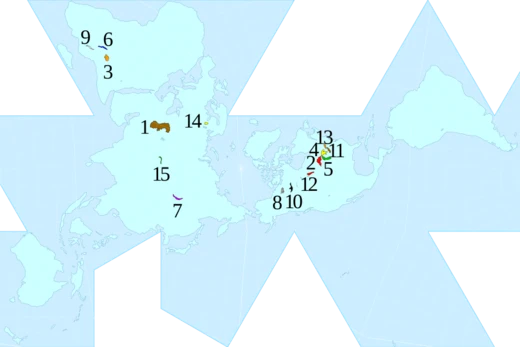
Lake Winnipeg
A large, shallow Canadian lake with the largest watershed in Canada.

Lake Winnipeg is a 24,514-square-kilometre lake in the Canadian province of Manitoba, its southern end about 55 kilometres north of the namesake city, Winnipeg. It is the 12th largest lake on Earth, Canada's sixth-largest freshwater lake, and the third-largest freshwater lake contained entirely within Canada. It is relatively shallow, with a mean depth of 12 metres, and its deepest section is a narrow 36-metre deep channel between the northern and southern basins. The lake has the largest watershed of any lake in Canada, receiving water from four provinces and four U.S. states, and drains northward into the Nelson River as part of the Hudson Bay watershed.
- Area
- 24,514 square kilometres (9,465 square miles)
- Mean depth
- 12 metres (39 feet)
- Maximum depth
- 36 metres (118 feet)
- Length
- 416 km (258 mi) from north to south
- Watershed area
- 982,900 square kilometres (379,500 sq mi)
- Outflow
- Nelson River at 2,066 cubic metres per second (72,960 cu ft/s)
- UNESCO designation
- Pimachiowin Aki (2018)
Verified Timeline
Lore & Background
Lake Winnipeg is a remnant of prehistoric Glacial Lake Agassiz, with evidence of a desiccated south basin approximately 4,000 years ago. The area between the lakes is called the Interlake Region, and the whole region is called the Manitoba Lowlands. The lake's east side has pristine boreal forests and rivers that were inscribed in 2018 as Pimachiowin Aki, a UNESCO World Heritage Site. Henry Kelsey is believed to have been the first European to see the lake, in 1690, adopting the Cree name wīnipēk, meaning 'muddy waters.' La Vérendrye referred to the lake as Ouinipigon when building the first forts in the area in the 1730s. The lake lies along one of the oldest trading routes in North America to have flown the British flag, used for fur trade between York Factory on Hudson Bay over Lake Winnipeg and the Red River Trails to the confluence of the Minnesota and Mississippi Rivers. In 2016, the Indigenous place name Weenipagamiksaguygun was approved by the Geographical Names Board of Canada. The lake supports more fish species than any other lake in Canada west of the Great Lakes, with 60 of 79 native Manitoba species present. It provides globally significant nesting sites for American white pelicans at Pipestone Rocks, where an estimated 3.7% of the world's population nested in 1998, and for piping plovers at Gull Bay Spits. However, the lake faces environmental issues including cyanobacteria blooms from excessive phosphorus, zebra mussel infestation, and was declared 'threatened lake of the year' in 2013 by the Global Nature Fund.
Reader's Guide
Lake Winnipeg is significant as one of the world's largest freshwater lakes and a key component of Canada's hydrological system. Its vast watershed, measuring about 982,900 square kilometres, collects water from four Canadian provinces (Alberta, Saskatchewan, Ontario and Manitoba) and four U.S. states (North Dakota, Minnesota, South Dakota and Montana), draining northward into the Nelson River at an average annual rate of 2,066 cubic metres per second. This watershed area was known as Rupert's Land when the Hudson's Bay Company was chartered in 1670, and the lake served as a vital transportation route for fur trade, with steamboats including Anson Northup, City of Selkirk, Colvile, Keenora, Premier, Princess, Winnitoba, Wolverine and the diesel-powered MS Lord Selkirk II plying its waters before and after railways reached Manitoba. The lake's ecological importance is underscored by its high fish diversity—more than any other Canadian lake west of the Great Lakes—and its role as a habitat for colonial nesting birds and migratory waterfowl. Two globally significant fall migration staging areas exist: the sand bars east of Riverton and the Netley-Libau Marsh where the Red River enters the lake. Manitoba Hydro uses the lake as one of the largest reservoirs in the world. The lake is 416 km from north to south, with remote sandy beaches, large limestone cliffs, and many bat caves in some areas. Communities on the lake include Grand Marais, Riverton, Gimli, Winnipeg Beach, Victoria Beach, Pine Falls, Berens River, Bloodvein, and Grand Rapids, with pleasure beaches on the southern end popular in summer, attracting many visitors from Winnipeg approximately 80 km south.
Did You Know?
- Lake Winnipeg has the largest watershed of any lake in Canada, measuring about 982,900 square kilometres.
- The lake's deepest section is a narrow 36-metre deep channel between the northern and southern basins.
- Pipestone Rocks hosted an estimated 3.7% of the world's American white pelican population in 1998.
- Henry Kelsey is believed to have been the first European to see the lake, in 1690, adopting the Cree name wīnipēk meaning 'muddy waters'.
- The lake was declared 'threatened lake of the year' in 2013 by the Global Nature Fund.
Frequently Asked Questions
Who is Lake Winnipeg?
Lake Winnipeg is a large, shallow freshwater lake situated in Manitoba, Canada, roughly 55 km north of the city that shares its name. It ranks as the twelfth-largest lake on the planet and holds the distinction of being the third-largest freshwater body that lies entirely within Canadian borders.
What are Lake Winnipeg's powers and role?
The lake commands the single largest drainage basin of any Canadian lake, collecting water from portions of four provinces and four U.S. states. Its outflow feeds the Nelson River at a rate of about 2,066 cubic metres per second, ultimately delivering water into the Hudson Bay watershed.
How does Lake Winnipeg's story end?
Rather than a dramatic finale, Lake Winnipeg's narrative resolves gradually as its waters exit through the Nelson River and flow northward into Hudson Bay. This slow, steady discharge has been the lake's ending for millennia, shaping the broader Hudson Bay drainage system.
Why is Lake Winnipeg important?
Its enormous 982,900-square-kilometre watershed makes it a critical hydrological hub for both Canada and the northern United States. Beyond its ecological role, it serves as a major freshwater resource and transportation corridor for the province of Manitoba.
What are Lake Winnipeg's key stats?
The lake stretches roughly 416 km from north to south, covers about 24,514 square kilometres, and averages just 12 metres in depth with a maximum of 36 metres. These figures reflect its character as a broad, shallow body of water rather than a deep basin.
More in Lakes Of The World 1-18
Spotted an error? Know more?
This is a living reference — every entry is fact-audited, and reader corrections feed straight into our audit queue. Suggest an edit · See this site's audit record