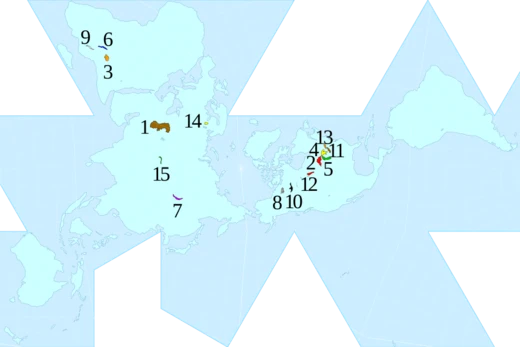
Poyang Lake
China's largest freshwater lake, vital for wildlife and history.

Poyang Lake is the largest freshwater lake in China, located within Jiujiang Prefecture in Jiangxi Province. It is fed by the Gan, Xin, and Xiu rivers and flows northward into the Yangtze River through a channel. The lake's area fluctuates dramatically between the wet and dry seasons, but in recent years the size has been decreasing overall. In a normal year the area averages 3,500 square kilometers. In early 2012, drought, sand quarrying, and water storage at the Three Gorges Dam lowered the area to about 200 square kilometers. The lake provides a habitat for half a million migratory birds and is a favorite destination for birding. During winter, up to 90% of the critically endangered Siberian crane spends the winter there.
- Location
- Jiujiang Prefecture, Jiangxi Province, China
- Type
- Freshwater lake
- Normal area
- 3,500 square kilometers (1,400 mi²)
- Greatest historical area
- 6,000 square kilometers (2,300 mi²) during the Tang dynasty
- Primary inflows
- Gan, Xin, and Xiu rivers
- Outflow
- Yangtze River
- Notable event
- Battle of Lake Poyang (1363)
Verified Timeline
Lore & Background
Poyang Lake was historically called Pengli Lake, but they are not the same. Before the Han dynasty, the Yangtze followed a more northerly course through what is now Longgan Lake; Pengli Marsh formed the lower reaches of the Gan River. The area that is now Poyang Lake was a plain along the Gan River. Around AD 400, the new more southerly course of the Yangtze River switched again, causing the Gan River to further back up and form Lake Poyang. The lake was named for Poyang County, which it flooded along with Haihun County, forcing a mass migration to Wucheng Township in what is now Yongxiu County. Wucheng thus became one of the great ancient townships of Jiangxi Province. This migration gave birth to the Chinese idiom, 'Drowning Haihun County gives rise to Wucheng Township.' Poyang was named for the earlier Po County of the Qin dynasty, in turn named for the city of Poyi in the state of Chu. Lake Poyang reached its greatest size during the Tang dynasty, when its area reached 6,000 square kilometers. In 1363, the Battle of Lake Poyang took place there; the battle is claimed to be the largest naval battle in history.
Reader's Guide
Poyang Lake is a dynamic ecological and historical landmark. Its area fluctuates dramatically between wet and dry seasons, but in recent years the size has been decreasing overall. In early 2012, drought, sand quarrying, and water storage at the Three Gorges Dam lowered the lake's area to about 200 square kilometers. The lake provides habitat for half a million migratory birds, including up to 90% of the critically endangered Siberian crane during winter. A fishing ban has been in place since 2002. In January 2020, China imposed a 10-year fishing moratorium on 332 sites along the Yangtze, including Poyang Lake, to protect marine biodiversity. The finless porpoise, locally known as the jiangzhu, is native to the lake. In 2007, there were about 500 in Poyang and Dongting Lakes, with population levels less than half of 1997 levels and dropping at a rate of 7.3 percent per year. Sand dredging has become a mainstay of local economic development but has been the principal cause of death of local wildlife. Dredging makes waters muddier, and large ships enter and leave the lake at the rate of two per minute, making it difficult for porpoises to hear food and swim freely. Construction of Poyang Lake Dam is expected to cause devastating effects on the remaining porpoises. The Jiangxi local government has proposed the dam to maintain water levels, but scientists and groups like the World Wide Fund for Nature have criticized the proposal. In 2019, Conservation International China began work in the Poyang Lake basin applying the Freshwater Health Index approach.
Did You Know?
- In early 2012, drought, sand quarrying, and water storage at the Three Gorges Dam lowered the lake's area to about 200 square kilometers, compared to a normal average of 3,500 square kilometers.
- Up to 90% of the critically endangered Siberian crane spends the winter at Poyang Lake.
- The finless porpoise population in Poyang and Dongting Lakes was about 500 in 2007, less than half of 1997 levels, dropping at 7.3 percent per year.
- The Chinese idiom 'Drowning Haihun County gives rise to Wucheng Township' originated from the lake's formation flooding Haihun County and creating Wucheng Township.
- The Battle of Lake Poyang in 1363 is claimed to be the largest naval battle in history.
Frequently Asked Questions
Who is Poyang Lake?
Poyang Lake is the largest freshwater lake in China, sitting within Jiujiang Prefecture in Jiangxi Province. It is fed by the Gan, Xin, and Xiu rivers and drains northward into the Yangtze River.
What are Poyang Lake's powers/role?
The lake is famous for its dramatic seasonal swings in surface area, shifting from roughly 3,500 square kilometers up to a historical peak of about 6,000 square kilometers during the Tang dynasty. It also serves as a critical stopover habitat for millions of migratory birds each year.
How does Poyang Lake's story end?
Poyang Lake's most legendary chapter was the 1363 Battle of Lake Poyang, widely regarded as the largest naval engagement ever fought. Beyond that single dramatic event, the lake continues its ongoing narrative through its seasonal cycles and ecological role.
Why is Poyang Lake important?
It anchors China's freshwater ecosystem as the country's biggest inland lake and provides essential wintering grounds for migratory waterfowl. Its position as a channel into the Yangtze also makes it a key hydrological link in one of the world's major river systems.
What is Poyang Lake's size?
Under normal conditions the lake covers about 3,500 square kilometers (1,400 mi²), though historical records from the Tang dynasty place its maximum extent near 6,000 square kilometers (2,300 mi²).
More in Lakes Of The World 1-18
Spotted an error? Know more?
This is a living reference — every entry is fact-audited, and reader corrections feed straight into our audit queue. Suggest an edit · See this site's audit record